
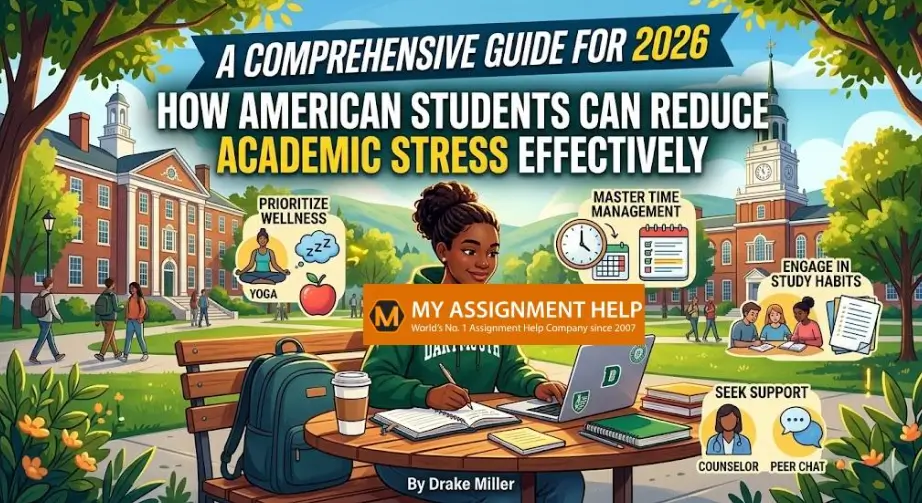
How American Students Can Reduce Academic Stress Effectively: A Comprehensive Guide for 2026
In the high-pressure environment of American education, the pursuit of academic excellence often comes at a significant cost: mental well-being. From the competitive race for Ivy League admissions to the relentless cycle of standardized testing and extracurricular padding, high school and college students in the U.S. are facing unprecedented levels of stress.
According to the American Psychological Association (APA), teens report stress levels that exceed what they believe to be healthy, and during the school year, these levels often surpass those of adults. If you are a student feeling the weight of the world on your shoulders, it is time to shift the narrative. Success should not be measured by your level of exhaustion.
This guide explores comprehensive, actionable strategies to help American students manage academic pressure, regain control of their schedules, and foster a healthier relationship with their studies.
TL;DR: Quick Wins for Reducing Stress
- Audit Your Time: Use the Eisenhower Matrix to separate “busy work” from “impact work.”
- Ask Early: Don’t wait for a failing grade to visit office hours or seek specialized support.
- Protect Your Biology: Sleep is a cognitive enhancer; all-nighters are cognitive disruptors.
- Focus on Depth: Two meaningful extracurriculars beat ten superficial club memberships.
Understanding the Landscape of Academic Stress in the U.S.
To solve a problem, one must first understand its roots. For American students, stress is rarely about a single exam. It is a “perfect storm” of systemic and social factors:
- The “College Prep” Culture: In many U.S. high schools, the pressure to build a “perfect” resume starts in freshman year. The focus has shifted from learning to “collecting” achievements.
- Financial Stakes: With the rising cost of tuition, the pressure to secure scholarships or maintain GPAs for financial aid adds a layer of economic anxiety. Students often juggle part-time jobs with heavy course loads, leading many to search for ways to pay someone to do assignment tasks so they can focus on their primary core subjects.
- Social Comparison: Platforms like Instagram and LinkedIn create a “hustle culture” where students feel they aren’t doing enough compared to their peers.
- The Burden of Choice: With thousands of electives, AP courses, and extracurriculars, the “paradox of choice” leads to decision fatigue and eventual burnout.
1. Master the Art of Strategic Time Management
One of the greatest contributors to stress is the feeling of being “behind.” When your To-Do list feels like an insurmountable mountain, the brain enters a “freeze” state. To combat this, you must move from passive scheduling to active prioritization.
The Eisenhower Matrix
Not all tasks are created equal. Use the Eisenhower Matrix to categorize your work into four quadrants. This prevents you from spending your most productive hours on low-impact activities.
- Quadrant 1 (Urgent & Important): These are “crises.” Do these immediately (e.g., an essay due tomorrow).
- Quadrant 2 (Important but Not Urgent): This is where high achievers live. Schedule these (e.g., long-term research, studying for a final that is two weeks away).
- Quadrant 3 (Urgent but Not Important): Delegate or minimize (e.g., certain club emails or social obligations).
- Quadrant 4 (Neither): Eliminate (e.g., mindless scrolling or “productivity theater”).
The Pomodoro Technique
The human brain is not designed for four-hour marathon study sessions. Research in cognitive psychology suggests that focus begins to decay after 30 to 40 minutes.
Use the Pomodoro technique: work for 25 minutes of deep, uninterrupted focus, then take a 5-minute break. After four cycles, take a longer 30-minute break. This prevents cognitive fatigue, keeps your focus sharp, and makes large tasks feel less daunting.
2. Leverage Academic Support Systems Early
A common mistake American students make is waiting until they are in a state of academic crisis to ask for help. In the U.S. education system, resources are plentiful, but they require student initiative.
- Office Hours: In college, your professors and TAs are your best resources. Use office hours not just to ask about grades, but to clarify complex concepts. Building a relationship with faculty also helps with future letters of recommendation.
- Writing Centers: Most high schools and universities offer free peer-review services. Having a second pair of eyes on your work can reduce the anxiety of the “final submission.”
- Professional Assistance: Sometimes, the workload is objectively overwhelming due to personal circumstances or a particularly heavy credit load—especially in specialized fields like healthcare. Students requiring expert-level insights for clinical case studies often seek nursing assignment help at Myassignmenthelp.com to ensure their work meets rigorous academic standards.
3. Prioritize “Sleep Hygiene” Over “All-Nighters”
In U.S. campus culture, pulling an “all-nighter” is often worn as a badge of honor. Scientifically, however, it is a recipe for failure. Sleep deprivation impairs the hippocampus—the part of the brain responsible for forming new memories and consolidating information learned during the day.
How to fix your sleep (The 3-2-1 Rule):
- 3 Hours Before Bed: Stop eating heavy meals to prevent digestive issues from waking you up.
- 2 Hours Before Bed: Stop working. Give your brain time to “wind down” from academic problem-solving.
- 1 Hour Before Bed: Stop looking at screens. The blue light from phones inhibits melatonin production, making it harder to fall into a deep REM cycle.
4. Combat Perfectionism and “Imposter Syndrome”
Many high-achieving students in the U.S. suffer from “Imposter Syndrome”—the persistent fear of being exposed as a “fraud” despite their success. This leads to perfectionism, which is a major driver of procrastination.
- Done is Better Than Perfect: Aim for a “B+” draft first. You can’t edit a blank page. Once the ideas are down, you can refine them.
- Reframe Failure: In the U.S., we often see a bad grade as a reflection of our worth. Instead, view it as “data.” It tells you which study method didn’t work and where the specific knowledge gaps are.
- The “Spotlight Effect”: Realize that most people are too worried about their own performance to judge yours. This realization can lower the social anxiety associated with class presentations or group projects.
5. Incorporate Physical Movement and Mindfulness
You cannot treat your head like it’s disconnected from your body. Physical activity is one of the fastest ways to clear cortisol (the stress hormone) from your system.
- The 10-Minute Walk: Research shows that a short walk in nature can significantly boost creativity and reduce rumination.
- Mindfulness and Breathwork: Taking five minutes to practice deep breathing before an exam can lower your heart rate and improve focus. Tools like Headspace or Calm have become staples for American students for a reason.
6. Curate Your Social Circle
The “Stress Contagion Effect” is real. If your entire friend group spends their time complaining about how stressed they are and competing over who slept the least, you will naturally feel more anxious.
Seek out “academic accountability partners”—friends who are focused and organized but also prioritize balance. Surrounding yourself with people who have a healthy perspective on school will naturally influence your own habits.
7. Use Technology as a Tool, Not a Distraction
While smartphones are often the source of distraction, they can also be your greatest ally in reducing stress through better organization.
- Digital Skills & Literacy: Knowing how to use research co-pilots responsibly or utilizing advanced note-taking systems like Notion or Obsidian can save hours of manual labor.
- Focus Blockers: Use apps like “Freedom” or “Cold Turkey” to block distracting websites during your Pomodoro sessions.
- Centralized Planning: A cluttered desk leads to a cluttered mind; the same applies to your digital files. Keep a centralized calendar for all deadlines.
8. Financial Stress and Academic Performance
For many American students, the stress of “doing well” is tied to the fear of losing merit-based scholarships. This “high-stakes” environment makes every quiz feel like a life-or-death situation.
- Financial Aid: Talk to your financial aid office early if you are struggling. They often have emergency grants or advice on managing your tuition.
- Resource Management: Look for “Open Educational Resources” (OER) to save on the exorbitant costs of textbooks.
- Course Loading: If you are working a part-time job, be realistic about your capacity. It is often better to take one less class and excel in the others than to take a full load and risk burnout.
9. Setting Boundaries with Extracurriculars
The “well-rounded student” myth often leads to students joining ten clubs they don’t care about just for the sake of their resume.
The Solution: Depth over Breadth. Admissions officers and employers prefer to see deep involvement and leadership in two organizations rather than passive membership in ten. Drop the activities that drain your energy without providing fulfillment.
See also: Improve Your Online Strategy 928211246 Digital Services
Conclusion: Redefining the Student Experience
Academic stress is an inevitable part of the American educational journey, but it does not have to be a debilitating one. By implementing strategic time management, prioritizing physical health, and knowing when to seek professional academic support, you can navigate high school and university with your mental health intact.
Remember, your GPA is a number, but your well-being is your foundation. Without a strong foundation, even the tallest academic achievements will eventually crumble. Take a breath, organize your desk, and remember that you are more than your grades.
Frequently Asked Questions
Q.1 How can I tell the difference between “normal” school stress and burnout?
While general stress often fluctuates based on your current workload, burnout is characterized by a persistent sense of emotional exhaustion, cynicism toward your studies, and a feeling of reduced personal accomplishment. If you find that even after a full weekend of rest you still feel “drained” or indifferent toward your goals, you may be experiencing burnout.
Q.2 Is it ever okay to drop an Advanced Placement (AP) or Honors course?
Yes. While rigorous courses look good on transcripts, a “C” in an AP class often weighs heavier on your mental health and GPA than a “B+” or “A” in a standard course. If a specific subject is consuming 80% of your study time and causing significant distress, it is strategically sound to prioritize your overall academic balance.
Q.3 How do I explain my academic stress to my parents?
Focus on “data” rather than just “feelings.” Instead of saying “I’m stressed,” try: “I am currently balancing six subjects and two clubs, and I’ve noticed my sleep has dropped to five hours a night, which is affecting my focus.” This helps parents see the situation as a logistical challenge that requires a solution, such as re-evaluating your schedule.
Q.4 Can digital tools actually help, or are they just more distractions?
Technology is a double-edged sword. To make it an ally, use “forcing functions” like website blockers during study sessions. When used correctly, digital skills like automated citation management and centralized task tracking can save you up to five hours of manual labor per week.
Q.5 What should I do if I have an “academic emergency” right before a deadline?
First, breathe. Second, communicate. Contact your instructor as early as possible—even a few hours’ notice is better than nothing. If the gap between your knowledge and the assignment requirements is too wide to bridge alone, consider leveraging professional academic support services to get back on track without compromising your health.
About the Author – Drake Miller
I am a passionate blog author associated with Myassignmenthelp.com, known for creating informative and engaging academic content for students worldwide. He specializes in topics related to education, assignment writing, study strategies and student success. Through his well-researched blogs, Drake helps learners discover practical solutions to academic challenges while staying updated with modern education trends.